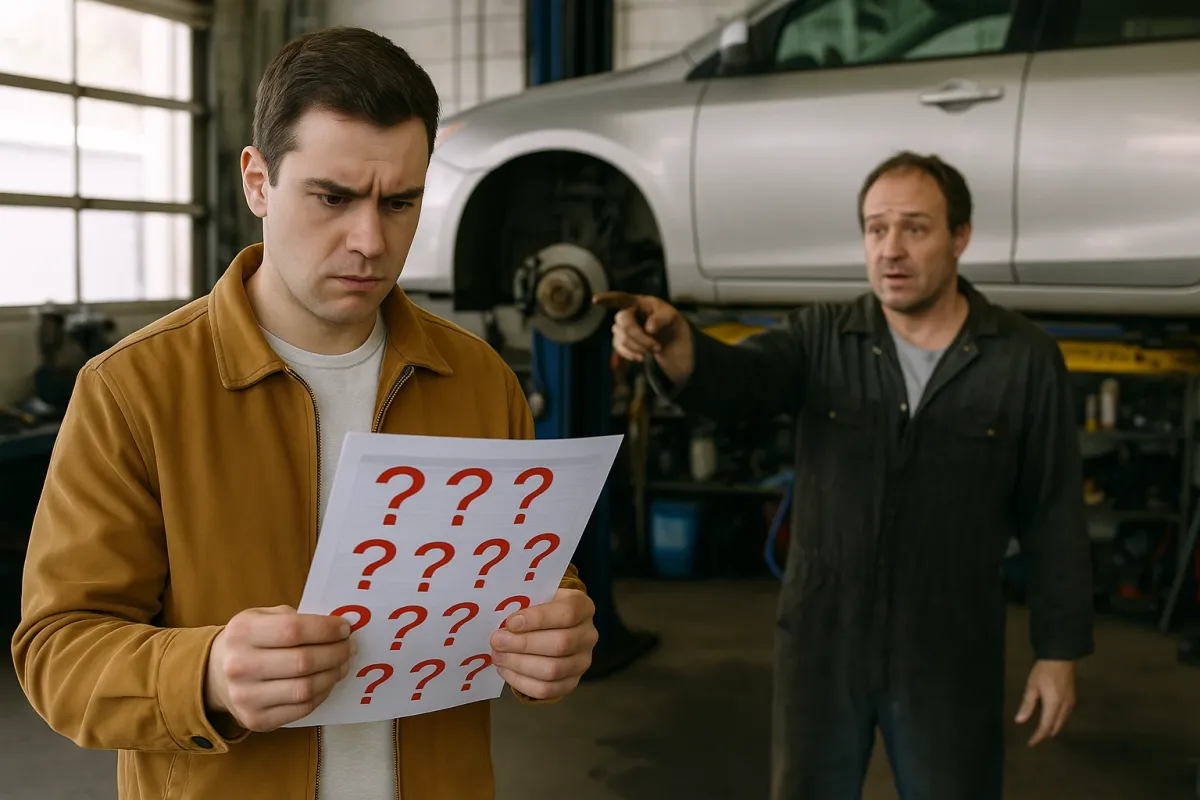
Online right now, people are venting about the “worst work emails” they’ve ever received—threads full of vague, passive‑aggressive, and downright confusing messages from bosses and coworkers are going viral on Twitter/X. If you’ve ever opened an auto repair estimate and felt the same sinking “what does this even mean?” feeling those office workers are describing, you’re not alone. In the repair world, unclear communication doesn’t just annoy you—it can cost you real money and leave your car half‑fixed.
Inspired by those frustrating work‑email stories, this guide translates shop‑speak into plain English and walks you through five practical, step‑by‑step checks you can do yourself before (or after) you get a quote. Use these steps to verify what a shop is telling you, ask sharper questions, and confidently decide what you can DIY and what truly needs a pro.
1. Turn That “Your Brakes Are Shot” Note Into a Simple DIY Brake Check
A lot of drivers get an email or text from the shop saying something like, “Front brakes at 3 mm – recommend pads and rotors ASAP.” That sounds urgent and vague at the same time. Here’s how to ground that message in reality with a quick driveway inspection.
- Park on a level surface, set the parking brake, and chock a wheel with a brick or wood block for safety.
- Loosen (but do not remove) the lug nuts on the wheel in question, then jack up the car using the factory jack point and place a jack stand under a solid frame point. Never rely only on the jack.
- Remove the wheel and visually inspect the brake pads through the caliper opening. You’ll see a metal backing plate and a friction material block. If the friction material is roughly the thickness of two stacked credit cards or less (around 3 mm), replacement is due soon.
- Run your finger gently along the rotor surface (careful, it may be sharp). Light grooves are normal; deep ridges or heavy rust lip on the outer edge suggest the rotor is worn.
- Compare left and right sides: if one pad is much thinner than the other, you may have a sticking caliper, which is a different conversation with the shop than “just pads and rotors.”
- Take a clear photo of the pad and rotor with a coin (like a quarter) for scale. Now, when a shop sends that “3 mm” email, you can reply with photos and specific questions: “Can we do pads only? Are my rotors within spec?”
- If you decide to DIY, make sure you also plan for brake cleaner, brake grease, a torque wrench, and possibly a caliper piston tool. Don’t start the job until you know you have every part and tool you’ll need.
By doing this quick check, you turn a vague “urgent” message into a data‑based decision—whether that’s scheduling a pro or ordering parts for a weekend project.
2. Decode “Low Battery Health” Warnings With a Simple Home Test
Modern shops (and even dealers) often send digital inspections that say “Battery marginal – recommend replacement” after a quick test with an electronic battery tester. That can be legit—or just a way to upsell while you’re in for an oil change. Here’s how to verify their email with your own quick test.
- Start with the basics: with the engine off, pop the hood and visually inspect the battery. Look for corrosion (white/green fuzzy buildup) on the terminals, cracked case, swelling, or acid leaks. Any physical damage means replacement is non‑negotiable.
- Check the date code on the battery sticker. It’s usually a letter for the month (A = January, B = February, etc.) and a number for the year (4 = 2024, 5 = 2025). Once you’re past 4–5 years, most batteries are living on borrowed time, especially in very hot or cold climates.
- If you have a multimeter, measure resting voltage after the car has been off for at least 30 minutes. 12.6V or more is healthy, 12.2–12.4V is borderline, under 12.0V is discharged or failing.
- Do a simple “headlight load test”: with the engine off, turn on headlights for 2 minutes, then measure voltage again. A dramatic drop (for example, from 12.4V to 11.6V) suggests the battery can’t handle load anymore.
- Start the engine and measure voltage at the battery with everything off. You should see 13.8–14.4V; much lower suggests alternator/charging issues, not just a bad battery.
- Clean light corrosion using a mix of baking soda and water and a wire brush, then re‑test. Sometimes a shop sees low voltage through dirty terminals and blames the battery.
- Armed with these numbers, you can reply to that “marginal battery” email with context: “Battery is 6 years old and shows 11.8V after a light load—let’s replace,” or “Battery is 2 years old and still tests at 12.6V—can we recheck the charging system instead?”
This simple test keeps you from reflexively accepting every “replace ASAP” note and helps you schedule battery work on your terms, not just when it appears on a quote.
3. Translate “We Noticed Oil Leaks” Into a Clear Source Check
One of the most anxiety‑inducing messages to get from a shop is, “We noticed oil leaks – recommend reseal.” That can sound like thousands of dollars—or it can be as minor as a loose drain plug. Before you panic, you can do a basic leak investigation yourself.
- First, confirm your engine oil level. Pull the dipstick when the engine is cool and the car is on level ground. If you’re still within the safe range and haven’t had to top up frequently, the leak may be minor seepage rather than an emergency.
- Lay down cardboard or a clean drip pan under the engine area overnight. Fresh drips will show you where and how much is falling. Mark the spots so you can see patterns over a few days.
- With the engine cool, crawl under with a flashlight. Check around the oil drain plug, oil filter, and lower edges of the oil pan. Fresh, wet oil (shiny) is more important than old, dark, dusty residue.
- Wipe suspect areas clean with a rag and a bit of brake cleaner, then drive a short trip and re‑check. New oil trails will clearly trace back toward the source (valve cover gasket, oil filter, drain plug, etc.).
- Pay attention to smell and location: burning oil smell from high in the engine bay often points to a valve cover gasket leak dripping onto a hot exhaust, while oil at the very front bottom center could be a front main seal or timing cover—which is a more complex, labor‑heavy job.
- Take detailed before‑and‑after photos and attach them when you respond to the shop’s email: “I cleaned and tracked the leak; it looks like the oil filter area, not the rear main. Can we start with that?”
- If the leak is minor seepage with no measurable loss between oil changes, you might opt to monitor it rather than immediately pay for an expensive reseal. Ask the shop for the specific source, not just “leaking,” and compare their description to what you saw.
This way, the phrase “we noticed oil leaks” becomes a starting point for a focused repair conversation, not an automatic green light for major engine work.
4. Turn “Recommended Alignment” Notes Into a DIY Tire & Suspension Check
Shops frequently add “Recommend alignment” on inspection reports—even when they haven’t driven the car much. Before you approve that on an upsell email, you can run some quick checks that tell you whether an alignment is truly needed or if something else is going on.
- Visually inspect your tires in daylight. Look at the tread on the inner edge, center, and outer edge. Feathering (sharp edges in one direction), cupping (scalloped dips), or heavy wear on one edge are stronger signs of alignment or suspension issues than a vague note on a report.
- Use a penny or tread gauge across the width of the tire. Uneven measurements left‑to‑right or inside‑to‑outside on the same tire usually mean you need an alignment and/or suspension component inspection.
- Take the car on a straight, flat road and briefly loosen your grip on the wheel. A gentle drift with the crown of the road can be normal; a strong pull to one side or a steering wheel that’s off‑center is a red flag.
- With the car parked, grab each front wheel at 12 and 6 o’clock, then 3 and 9 o’clock, and wiggle. Any clunking or excessive play suggests worn ball joints, tie‑rod ends, or wheel bearings. Those should be repaired before you even pay for an alignment.
- Check tire pressures and adjust to the specs on the door jamb label, not what’s on the tire sidewall. Under‑ or over‑inflation can mimic alignment issues and cause uneven wear on its own.
- If you’ve recently hit a major pothole, curb, or road debris, mention that when you talk to the shop; it supports the case for a true alignment need and makes you sound like you’re paying attention.
- If everything looks and feels fine, and your tires are wearing evenly, reply to the shop: “Can you show me the before/after alignment printout from your machine?” A legit alignment shop will have no problem providing this; if they can’t, that “recommendation” may not be worth much.
This quick evaluation keeps you from reflexively accepting every “alignment recommended” line item and helps you decide whether it’s time for an adjustment or a deeper suspension inspection.
5. Make Sense of “Check Engine Light” Diagnostics With a Free Code Scan
One of the most intimidating notes you can get—whether in person or as a follow‑up email—is “Check Engine Light on – needs further diagnosis.” That phrase can hide anything from a loose gas cap to a failing catalytic converter. Before you sign off on hours of diagnostic labor, get some information of your own.
- If the check engine light is flashing, do not drive the car except to safely pull over; schedule a tow. Flashing indicates a severe misfire that can damage your catalytic converter quickly.
- For a solid light, stop by an auto parts store like AutoZone, O’Reilly, or Advance Auto; many offer free OBD‑II code scans. Ask them to print or text you the codes, not just a sales recommendation.
- Plug in a cheap OBD‑II scanner (often under $30 online) if you’d rather do it at home. With the ignition in the ON position (engine off), plug the scanner into the port under the dash and follow on‑screen prompts to read codes.
- Write down each code (for example, P0301, P0420, P0442) along with the “freeze frame” data if available (engine temp, speed, etc.). This context is powerful when you talk to a shop.
- Research the code briefly from reputable sources (manufacturer forums, service bulletins, or trusted sites). For example, a P0457 (EVAP system – loose fuel cap) really does often mean… a loose fuel cap. Tighten the cap, clear the code, and see if it returns.
- If the same code comes back quickly, especially under similar conditions (cold start, highway speed, etc.), that’s valuable info. Tell the shop: “I’m consistently getting P0301 on cold starts only; no other codes.” That can significantly shorten paid diagnostic time.
- When you receive a quote from the shop that says “needs new ___,” ask them: “Which codes did you see, and what tests did you perform to confirm that part is bad?” A good shop will explain in clear steps, not just “the computer says so.”
By doing this basic scan and note‑taking, you move from “totally in the dark” to “informed partner” in the diagnostic process, trimming guesswork and unnecessary parts swapping.
Conclusion
The viral thread of “worst work emails” resonates because almost everyone has seen a message that’s vague, confusing, or quietly expensive if you misread it. Auto repair communication can feel the same way—only your money and safety are on the line. By learning a few simple DIY checks for brakes, batteries, oil leaks, alignment, and check‑engine lights, you turn those generic shop notes into specific, informed decisions.
You don’t need to become a full‑time mechanic; you just need enough knowledge to ask better questions and confirm the basics yourself. The next time a shop sends you a cryptic “recommendations” email, treat it like those office horror stories going viral right now—but instead of just sharing the frustration, use these steps to translate, verify, and choose the repair path that actually makes sense for you and your car.
Key Takeaway
The most important thing to remember from this article is that following these steps can lead to great results.