Modern appliances are packed with electronics, sensors, and smart features—but that doesn’t mean every problem needs a brand-new machine. Many “it’s dead” or “it’s broken” moments come down to simple issues you can safely fix with basic tools and a bit of patience. This guide walks through five practical, step‑by‑step repair tips that DIY‑minded homeowners can use to bring their appliances back from the brink and stretch their lifespan.
Always unplug or shut off power at the breaker before opening or working on any appliance, and shut off water or gas where applicable. If anything smells like burning, involves gas leaks, or feels beyond your comfort level, stop and call a pro.
1. When Your Fridge Stops Cooling: How to Restore Airflow and Efficiency
A warm fridge doesn’t automatically mean a dead compressor. Airflow problems and dirty components are some of the most common—and fixable—causes.
Step‑by‑step: Clear airflow and clean critical components
Check temperature settings and load
Make sure the thermostat wasn’t bumped and the fridge isn’t overstuffed. Air needs space to circulate—leave a few inches between food and the back wall, and keep vents inside the fridge and freezer unobstructed.
Inspect and clean the condenser coils
- Unplug the fridge. - Locate the coils (typically on the back or underneath behind a toe kick panel). - Use a vacuum with a brush attachment and a coil brush to remove dust and pet hair. - Clean the surrounding floor area to reduce future buildup. Dirty coils make the compressor work harder and can cause poor cooling and even shutdowns.
Verify the condenser fan is spinning freely
- With the unit still unplugged, access the rear bottom panel. - Gently spin the condenser fan blade by hand. It should rotate freely without grinding. - If it’s stuck by debris, clear it carefully. If it’s wobbly or noisy, the fan motor may need replacement—a DIY job on many models with basic tools.
Inspect the door gaskets for leaks
- Close a dollar bill or sheet of paper in the door and gently pull. - If it slides out with almost no resistance, the seal is weak in that spot. - Clean gaskets with warm soapy water to remove grime that prevents a tight seal. - Warm and reshape slightly warped gasket sections with a hair dryer and press them into place. A leaky seal forces the fridge to run longer and cool less effectively.
Check for frost blocking the evaporator
- If the freezer is packed with frost, you may have a defrost issue, but sometimes it’s due to frequent door openings or a door left ajar. - Power off and let the fridge fully defrost with doors open (prepare towels). - Once thawed and restarted, monitor to see if frost rapidly returns—if it does, defrost components (heater, thermostat, or control board) may need professional diagnosis.
If the compressor is silent, hot to the touch, repeatedly clicking, or you notice oily residue under the fridge (possible refrigerant leak), it’s time for a qualified technician.
2. Washer That Won’t Drain: Clearing Clogs and Resetting the System
A washer full of soggy clothes and standing water is frustrating, but often the cause is simply a blocked filter, clogged pump, or kinked hose.
Step‑by‑step: Find and fix the drainage bottleneck
Kill power and prep for water spill
- Unplug the washer. - Place towels and a shallow pan or tray near the bottom front or back panel where you’ll work. - If your washer has a manual drain hose near the filter, use it to empty as much water as possible into a bucket.
Access and clean the drain filter (front‑loaders)
- Look for a small access door or panel at the lower front. - Twist the filter cap slowly; water will come out—catch it in your tray. - Remove the filter and clean out lint, coins, hair ties, and any debris. - Shine a flashlight into the cavity and remove anything stuck near the pump impeller.
Inspect the drain hose
- Pull the washer slightly away from the wall. - Check the drain hose for kinks, crushing, or sharp bends. - Detach the hose from the standpipe or sink and check for clogs (run water through it outdoors or in a large sink). - Confirm that the end of the hose is not pushed too far down into the standpipe, which can cause siphoning issues.
Check the pump for obstructions
- On many models, the pump is accessible from the front bottom panel or back panel. - With power still off, remove the access panel and inspect the pump housing. - Look for foreign objects (socks, hairpins, etc.) blocking the impeller. - If the impeller is jammed, gently free it; if it’s broken, the pump assembly will likely need replacement.
Test the drain cycle
- Reassemble the panels and reconnect the hose. - Plug in the washer and run a drain/spin cycle with no laundry. - Watch and listen: water should pump out steadily without unusual noise. If the pump hums but doesn’t move water (and you’ve cleared clogs), the pump motor may be failing and require replacement.
Avoid running the washer with partial disassembly or exposed wiring. If the circuit breaker trips or you smell burning insulation, stop and call a technician.
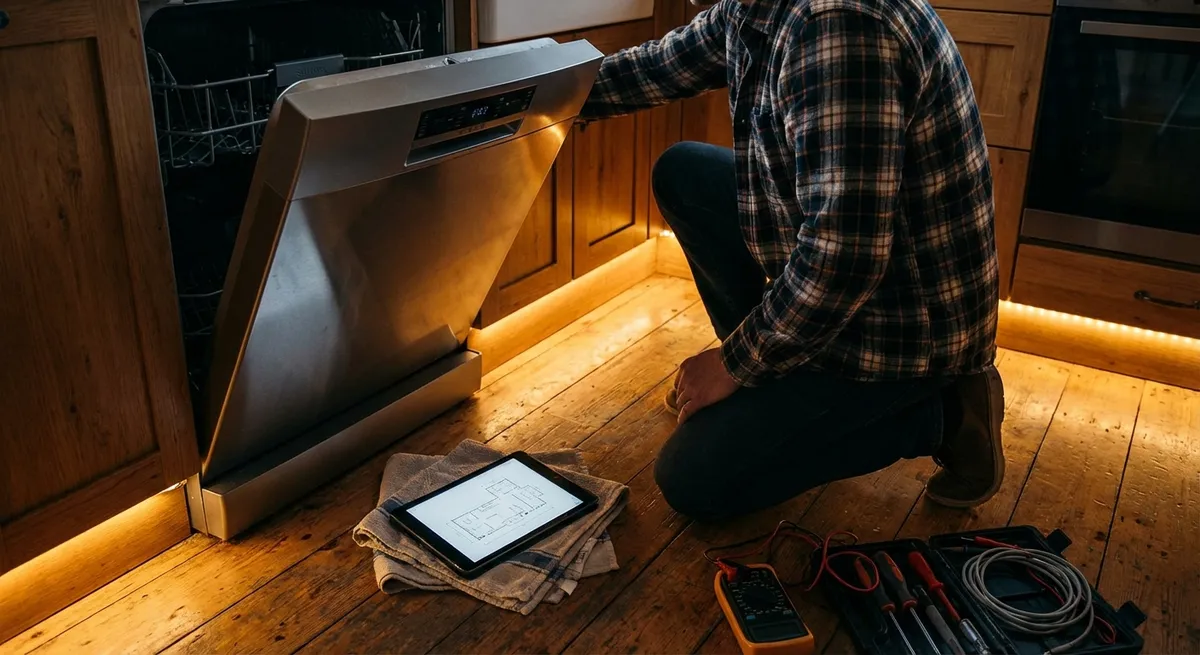
3. Dishwasher That Leaves Gritty Dishes: Restoring Spray Power and Cleaning Action
When dishes come out dirty or gritty, it’s usually not about expensive parts. Spray arms, filters, and water temperature are the main suspects.
Step‑by‑step: Boost cleaning performance at the source
Clean the filter and sump area
- Turn off power at the breaker or unplug the dishwasher (if accessible). - Remove the bottom rack. - Lift or twist out the lower filter assembly (on most modern dishwashers). - Rinse the filter under warm water and gently scrub with a soft brush to remove grease and food. - Inspect the sump area below for broken glass, bones, or food buildup and remove debris carefully.
Clear the spray arm jets
- Remove the lower spray arm (usually a center nut or clip) and the upper arm if it’s easily accessible. - Run water through them and use a toothpick or small brush to clear any clogged holes. - Soak the spray arms in warm vinegar solution if they’re scaled with mineral deposits.
Verify proper loading and detergent use
- Avoid blocking the spray arms with large pans or plates. - Don’t nest bowls and cups so water can’t reach inside. - Use detergent designed specifically for dishwashers, not dish soap. - If you have hard water, consider detergent with a built‑in rinse aid or add a separate rinse aid.
Confirm water temperature and supply
- Run the hot water at the kitchen sink for a minute before starting a cycle. - Use a thermometer to check tap temperature; most manufacturers recommend around 120°F (49°C) for best cleaning. - Make sure the dishwasher’s water inlet valve under the sink is fully open.
Run a maintenance clean cycle
- With the dishwasher empty, place a dishwasher‑safe cup of white vinegar on the top rack. - Run a hot cycle to dissolve grease and soap film. - Optionally, follow with a cycle using a dishwasher cleaner product to help remove limescale and buildup in hidden areas.
If dishes are still consistently dirty and you hear weak or no spraying during a cycle, the circulation pump or diverter valve may be failing, which is more advanced but often repairable with a model‑specific part and detailed instructions.
4. Electric Oven That Bakes Unevenly: Calibrating and Replacing a Hidden Culprit
If cookies burn on one side and stay raw on the other, or your recipes are always off, your oven may not be heating the way the control panel says it is. Frequently, this comes down to a worn heating element or a simple calibration issue.
Step‑by‑step: Check temperature and the heating elements
Verify actual temperature with an oven thermometer
- Place a reliable oven thermometer in the center of the middle rack. - Preheat your oven to a common temperature (e.g., 350°F / 175°C). - Wait 15–20 minutes after it beeps “preheated,” then check the thermometer. - Note whether it’s consistently off by the same amount (e.g., always 25°F low).
Adjust the oven’s temperature calibration (if available)
- Consult your owner’s manual (many manuals are available on the manufacturer’s website if you’ve lost the paper copy). - Many digital ovens allow you to offset the temperature by ±30–35°F through the settings menu. - Adjust in small increments and test again with the thermometer.
Inspect the bake and broil elements (electric ovens)
- Turn off power at the breaker—do not rely on just the control panel. - Open the oven and visually inspect the bake element (bottom) and broil element (top). - Look for visible damage: blisters, cracks, bright spots, or breaks. - If you see any damaged sections, the element must be replaced.
Test the element for continuity (optional but helpful)
- Remove the screws securing the element and gently pull it forward. - Disconnect the wires (note their positions or take a photo). - Use a multimeter set to continuity or ohms and check the element terminals. - No continuity = failed element; replace with the exact model‑specific part.
Reassemble and test baking performance
- Install the new element, reattach wires, and secure it with screws. - Restore power at the breaker. - Test bake function again with your thermometer and a simple bake (like a sheet of biscuits) to confirm even browning.
If temperatures swing wildly, the oven temperature sensor or control board might be malfunctioning. Sensors are usually easier DIY replacements; control boards are typically more complex and might justify a professional repair estimate versus replacement cost.
5. Dryer That Takes Forever: Restoring Safe, Efficient Airflow
A dryer that runs endlessly but never fully dries clothes is often struggling to move air—not necessarily failing to generate heat. Restricted airflow is not only inefficient; it’s a real fire risk.
Step‑by‑step: Clean and optimize the entire vent path
Check basic settings and load size
- Make sure you’re not overloading the dryer; clothes should tumble freely. - Use appropriate settings (heavy items like towels and jeans may need a higher heat or timed dry).
Clean the lint screen thoroughly
- Remove the lint filter and clear lint after every load. - Periodically wash the screen with warm soapy water and a soft brush to remove invisible film from dryer sheets and fabric softeners that reduce airflow.
Inspect and clean the vent hose
- Unplug the dryer (and shut off gas if it’s a gas dryer). - Pull it gently away from the wall and disconnect the vent hose. - Vacuum out lint from the hose and the dryer’s vent outlet. - If the hose is crushed, excessively long, or made of thin foil/flexible plastic, consider replacing it with a rigid or semi‑rigid metal duct for better airflow and safety.
Clear the exterior vent hood
- Locate the exterior vent on the outside of your home. - Remove any lint buildup from the flap and surrounding area. - Make sure the flap opens fully during dryer operation and isn’t blocked by nests, debris, or paint.
Evaluate vent length and configuration
- Long runs with multiple bends significantly reduce drying performance. - If possible, shorten the vent path or reduce the number of elbows. - For long or complex runs, consider an annual professional vent cleaning service to reduce fire risk and improve efficiency.
After cleaning, run a timed cycle with a normal load and check if drying time improves. If clothes are still damp after a full cycle and you’ve confirmed strong airflow at the exterior vent, the heating element, gas igniter, or thermostats may need diagnosis.
Conclusion
Most “my appliance is done for” moments come down to clogs, dirty components, blocked airflow, or minor part failures that a careful DIYer can tackle with simple tools. By systematically checking filters, vents, fans, and basic settings, you can often bring refrigerators, washers, dishwashers, ovens, and dryers back to solid, reliable performance—and delay costly replacements.
When in doubt, prioritize safety: disconnect power, shut off water or gas, and stop immediately if something seems risky. Use your model’s manual and official manufacturer resources for diagrams and part numbers, and call a professional for anything involving gas leaks, damaged wiring, or sealed refrigeration systems. A careful, informed DIY approach can save money, reduce waste, and keep your home running smoothly.
Sources
- [U.S. Department of Energy – Appliances and Equipment](https://www.energy.gov/energysaver/appliances-and-electronics) - General guidance on efficient appliance use and maintenance
- [Consumer Product Safety Commission – Clothes Dryer Safety](https://www.cpsc.gov/ClothesDryerSafety) - Official safety recommendations for dryers and vent cleaning
- [Energy Star – Refrigerator and Freezer Buying & Maintenance Tips](https://www.energystar.gov/products/refrigerators) - Guidance on proper refrigerator care, temperature settings, and efficiency
- [Whirlpool Corporation – Product Help & Repair Videos](https://www.whirlpool.com/services/product-help.html) - Manufacturer repair and troubleshooting information for common appliances
- [University of California, Davis – Home Energy Efficiency](https://energy.ucdavis.edu/home-energy-efficiency/) - Educational overview of household energy use and appliance performance
Key Takeaway
The most important thing to remember from this article is that this information can change how you think about Appliances.