Car trouble rarely happens when it’s convenient. Whether you’re in your driveway or on the side of the road, a few practical repair skills can turn a bad day into a minor delay. This guide walks through five step-by-step fixes that DIY-minded drivers can realistically handle with basic tools—no full garage or professional lift required.
Before You Start: Safety, Tools, and When to Stop
Working on your car can save money and time, but only if you stay safe and know your limits.
Always park on a flat surface, engage the parking brake, and switch off the engine unless a procedure specifically requires it running. Use wheel chocks (or blocks of wood) to prevent rolling, and never crawl under a car supported only by a jack—use jack stands on solid ground. Basic tools worth keeping in your trunk include a lug wrench, jack, jumper cables, a tire pressure gauge, a flashlight, a multi-bit screwdriver, adjustable wrench, gloves, and shop towels. Keep your owner’s manual handy; it often has diagrams and torque specs. If you smell fuel, see large fluid leaks, or notice smoke or electrical burning smells, stop and call a professional; some issues can escalate quickly into fire or severe engine damage. When in doubt—especially with brakes, steering, and airbags—err on the side of getting a qualified mechanic involved.
Step‑By‑Step: Changing a Flat Tire Safely
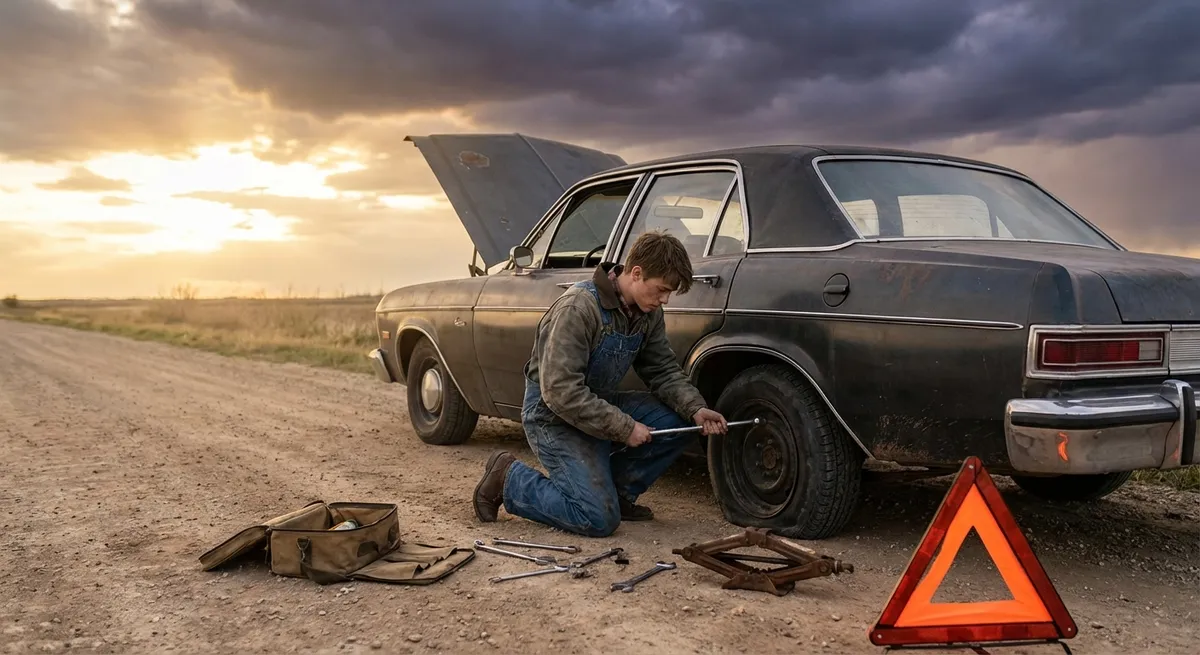
A flat tire is one of the most common roadside problems—and one of the most fixable if you prepare ahead of time.
Prepare the car and location
Pull as far off the road as safely possible, turn on hazard lights, and set the parking brake. Place wheel chocks (or large rocks) in front of and behind a tire opposite the flat to prevent rolling.
Gather and position your tools
Locate the spare tire, jack, and lug wrench—usually in the trunk or under the cargo floor. Check your owner’s manual for the correct jacking points; using the wrong spot can damage the car or cause the jack to slip.
Loosen lug nuts before lifting
Use the lug wrench to turn lug nuts counterclockwise about one turn each, but do not remove them yet. Loosening them while the tire is still on the ground gives you leverage and reduces the risk of the car shifting on the jack.
Lift the vehicle securely
Position the jack under the recommended jacking point near the flat tire and raise the car until the tire is about an inch off the ground. Avoid putting any part of your body under the car.
Remove the flat and mount the spare
Unscrew the lug nuts fully and remove the flat tire, pulling it straight toward you. Align the spare with the studs, slide it onto the hub, and hand‑tighten the lug nuts in a star pattern to seat the wheel evenly.
Lower the car and fully tighten
Lower the car until the spare just contacts the ground, then tighten the lug nuts firmly in a star pattern using the wrench. Lower the car completely and give each nut a final snug. Check the spare’s pressure as soon as you can, and remember that many compact spares are speed‑ and distance‑limited—follow the label on the tire.
Step‑By‑Step: Jump‑Starting a Dead Battery Without Damage
A dead battery doesn’t always mean the battery is finished; sometimes it’s just drained. Jump‑starting the right way protects both cars’ electronics.
Position the vehicles and prepare
Park the booster car close enough that the cables reach, but ensure the vehicles do not touch. Turn off both ignitions, remove keys, and switch off all accessories (lights, radio, climate control).
Identify positive and negative terminals
On both batteries, locate the positive (+, usually red) and negative (–, usually black) terminals. Clean off obvious corrosion with a rag if needed, but avoid touching it with bare hands; it can be caustic.
Connect cables in the correct order
- Red clamp to dead battery positive (+) - Red clamp to good battery positive (+) - Black clamp to good battery negative (–) - Final black clamp to an unpainted metal surface (engine bracket or chassis) on the dead car, away from the battery
This last step minimizes spark risk near the battery.
Start the booster car and wait
Start the car with the good battery and let it idle for a few minutes to charge the dead battery slightly. Avoid revving excessively; a gentle increase to around 1,500–2,000 RPM is usually enough.
Start the dead car
Try to start the car with the dead battery. If it doesn’t start within a few seconds, wait another couple of minutes and try again. Avoid repeated rapid attempts; that can overheat the starter.
Disconnect cables safely
Once the dead car starts, remove cables in reverse order: - Black clamp from metal ground on formerly dead car - Black clamp from good battery negative - Red clamp from good battery positive - Red clamp from formerly dead battery positive
Let the revived car run for at least 15–20 minutes, ideally by driving, to help recharge the battery. If it dies again quickly, the battery or charging system may need professional testing.
Step‑By‑Step: Fixing a Stuck Power Window (Temporary Bypass)
A window stuck down in bad weather or in a parking lot is more than annoying—it’s a security and comfort issue. While permanent repair may need parts, this can help in a pinch.
Confirm it’s not the child lock or switch issue
If it’s a rear window, check that the child safety lock for windows isn’t engaged. Try operating the window from both the door switch and the driver’s master switch.
Listen for clues
Press the window switch and listen: - Motor noise but no movement suggests a regulator or mechanical problem. - Silent suggests a power/switch issue or blown fuse.
Check the fuse
Consult your owner’s manual to locate the power window fuse. If it’s blown (metal strip inside is broken), replace it with one of the same amperage rating. If it blows again immediately, there may be a short or failing component that needs a pro.
Assist the window up (with care)
If you hear the motor trying, have a helper hold the switch in the “up” position while you place both hands flat on the glass, palms slightly apart. Apply even upward pressure—don’t twist the glass. Sometimes this helps the regulator catch and move the glass enough to close it.
Use temporary support if it won’t stay up
If you manage to get the window up but it starts sliding down, use painter’s tape or duct tape on the outside, from the top of the glass to the door frame, in multiple vertical strips. It’s not pretty, but it can hold the window closed until you can schedule a proper repair.
Know when to stop
If the glass feels jammed, crunches, or starts tilting, stop immediately to avoid shattering or derailing it inside the door. At that point, secure the car by parking in a safe, monitored area or using a temporary plastic cover and seek professional service.
Step‑By‑Step: Replacing a Headlight Bulb for Better Night Driving
A burned‑out headlight is a safety hazard and can earn you a ticket, yet many bulbs can be replaced in minutes with no special tools.
Identify the correct bulb type
Check your owner’s manual or the parts catalog at an auto parts store to find the exact bulb number for your vehicle. Some cars use separate bulbs for low and high beams; others share one.
Access the headlight housing
Open the hood and look behind the headlight assembly for a round or rectangular dust cover, wiring connector, or bulb holder. Some vehicles require removing an airbox, battery, or trim panel for access; if that looks extensive, consider whether you’re comfortable proceeding.
Disconnect the wiring connector
Gently unplug the electrical connector from the back of the bulb. There may be a tab, clip, or small lever to release. Avoid pulling on the wires themselves; grip the connector body.
Remove the old bulb
Depending on the design, twist the bulb counterclockwise or release a metal retaining clip and pull the bulb straight out. Note its orientation; many bulbs only fit in a specific alignment.
Install the new bulb correctly
Avoid touching the glass portion of halogen bulbs with bare fingers; oils can shorten their life. If you accidentally touch it, clean with rubbing alcohol and a lint‑free cloth. Insert the new bulb in the same orientation and lock it with a twist or the retaining clip.
Reconnect and test
Reattach the wiring connector and any dust cover you removed. Turn on your headlights to verify the new bulb works and matches the other side in brightness and color. If the beam looks wildly misaligned, your headlight aim may need adjustment per your manual or by a shop.
Step‑By‑Step: Stopping a Minor Coolant Leak in an Emergency
Coolant leaks can quickly overheat an engine, but a small leak from a hose or clamp can sometimes be temporarily controlled to limp to a shop.
Watch the temperature gauge first
If your temperature gauge rises into the red or you see a “Check Engine Temperature” warning, safely pull over, turn off the engine, and let it cool completely—this can take 30–45 minutes. Never open the radiator cap on a hot engine; escaping steam can cause serious burns.
Locate the leak source
After the engine cools, look for damp or crusty areas around hoses, hose connections, and the radiator. Common leak points include hose ends at clamps and plastic fittings. Use a flashlight and avoid touching hot components.
Tighten loose hose clamps
If you see coolant seeping around a hose connection and there’s a screw‑type clamp, use a screwdriver or nut driver to snug it a bit—do not overtighten and crush the hose. Check if the leak slows or stops.
Apply temporary hose repair for small splits
For a small crack in a rubber hose (not at the very end), you can wrap it tightly with high‑temperature hose repair tape or self‑fusing silicone tape, stretching as you wrap to create a tight seal. In a true pinch, a short length of hose and clamps from an auto parts store can be used to splice out a damaged section, but this is more advanced.
Top off coolant correctly
If the leak is minor and you’ve slowed it, refill the coolant reservoir to the proper mark using the correct coolant type for your vehicle (check the cap or manual). In an emergency only, clean water can be used short‑term, but it reduces corrosion protection and freeze/boil resistance.
Drive gently and monitor constantly
Drive only as far as necessary to reach a repair shop, keeping an eye on the temperature gauge. If the gauge climbs again or you see steam, pull over and shut off the engine immediately. A temporary fix is exactly that—temporary. Plan for a full, proper repair as soon as possible.
Conclusion
Being “roadside ready” isn’t about becoming your own full‑time mechanic—it’s about having enough practical know‑how to handle common problems safely and confidently. Changing a flat, jump‑starting a battery, nudging a stuck window closed, replacing a headlight, and stabilizing a small coolant leak are all within reach for most DIY‑minded drivers with basic tools and a calm approach. Build a small kit for your trunk, read your owner’s manual, and treat these skills as part of your regular driving toolkit. The next time something goes wrong, you’ll be far more likely to keep your day—and your car—moving.
Sources
- [National Highway Traffic Safety Administration (NHTSA) – Vehicle Maintenance Tips](https://www.nhtsa.gov/sites/nhtsa.gov/files/documents/811075.pdf) - Federal guidance on basic car maintenance and safety checks
- [AAA – How to Change a Tire](https://exchange.aaa.com/safety/driving-advice/how-to-change-a-tire/) - Step‑by‑step tire change instructions and safety precautions
- [Edmunds – How to Jump-Start a Car](https://www.edmunds.com/car-maintenance/how-to-jump-start-a-car-battery.html) - Detailed, modern guide to safe jump‑starting procedures
- [U.S. Department of Energy – Maintaining Your Vehicle](https://www.fueleconomy.gov/feg/maintain.jsp) - Official advice on maintenance practices that keep vehicles reliable and efficient
- [University of California, Berkeley – Vehicle Cooling System Basics](https://uhs.berkeley.edu/transportation/cooling-system) - Educational overview of cooling systems and overheating risks
Key Takeaway
The most important thing to remember from this article is that this information can change how you think about Auto Repair.