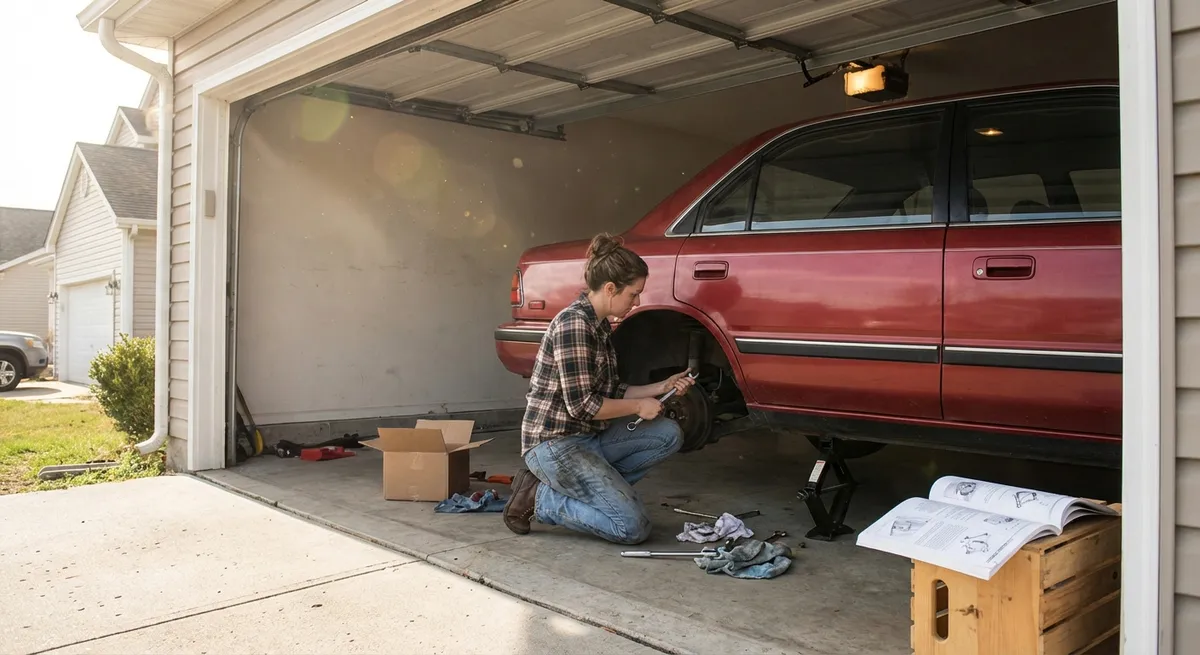
If you’ve ever stared at a repair quote and thought, “There’s no way it costs that much,” this is for you. Many everyday car issues don’t need a shop visit, just basic tools, a bit of patience, and clear instructions. This guide walks you through five practical, step-by-step repair jobs that DIY-minded drivers can handle safely at home—no lift, no fancy scan tools, just solid technique and realistic expectations.
Before You Start: Safety, Tools, and Smart Boundaries
Before turning a single bolt, set yourself up to succeed. Work on a flat, stable surface and use the parking brake and wheel chocks anytime you lift the car. A quality floor jack is helpful, but never rely on it alone—use properly rated jack stands and test that the car is stable before crawling underneath. Keep safety glasses and gloves nearby; brake dust, rust flakes, and hot fluids are not friendly to skin or eyes.
You don’t need a full professional toolbox, but a few basics go a long way: a metric and/or SAE socket set, combination wrenches, screwdrivers, pliers, a torque wrench, and a tire inflator with gauge. A basic code reader (OBD-II scanner) is increasingly useful and surprisingly affordable. Know your limits: anything involving airbags, major steering components, fuel system leaks, or structural damage typically belongs at a shop. Your goal isn’t to become a master tech overnight—it’s to confidently handle the straightforward jobs that keep your car reliable and your repair budget under control.
Step-by-Step Tip #1: Change Your Engine Oil Without Making a Mess
Regular oil changes are one of the highest-value DIY repairs you can do. They’re straightforward, repeatable, and build confidence for more advanced work.
What you’ll need
- Correct oil (type and viscosity per your owner’s manual)
- New oil filter and drain plug washer (if required)
- Oil drain pan and funnel
- Socket or wrench for the drain plug
- Oil filter wrench (if access is tight)
- Gloves, rags, and jack/jack stands if needed for access
Steps
Warm the engine slightly
Run the engine for 3–5 minutes, then shut it off. Warm (not hot) oil drains faster and carries away more contaminants.
Set up and lift if needed
Park on level ground, set the parking brake, and chock the rear wheels. If you must raise the car to reach the drain plug or filter, jack it at approved lift points and support it with jack stands.
Drain the old oil
Place the drain pan under the drain plug. Loosen the plug carefully, finishing by hand so you don’t drop it in the pan. Let the oil drain completely—this can take several minutes.
Replace the plug and washer
Inspect the drain plug and washer. Replace a crush washer if your car uses one. Reinstall the plug by hand to avoid cross-threading, then snug it with a wrench and finish with a torque wrench to the spec in your manual (over-tightening can strip threads).
Remove and prep the filter
Move the drain pan under the filter. Unscrew the old filter (use a filter wrench if tight). Check that the old rubber gasket came off with it—if it’s stuck to the engine, remove it to avoid a double gasket and potential leak.
Install the new filter
Lightly oil the new filter’s rubber gasket with fresh oil. Thread it on by hand until the gasket contacts the mounting surface, then tighten ¾–1 full turn more by hand (or per the filter’s instructions). Do not overtighten.
Add new oil and check level
Remove the oil filler cap on top of the engine, insert a funnel, and pour in the recommended amount minus about half a quart. Reinstall the cap, start the engine, and let it idle 30–60 seconds, checking under the car for leaks. Shut off, wait a couple of minutes, then check the dipstick and top up to the “full” mark.
Dispose of used oil properly
Pour the old oil into a sealed container. Most auto parts stores and many recycling centers accept used oil and filters for free. Never dump oil in the trash, on the ground, or down drains.
Step-by-Step Tip #2: Replace Worn Brake Pads Safely and Correctly
Brake pad replacement sounds intimidating, but on many vehicles it’s a very achievable DIY job—if you work methodically and respect safety. If your steering wheel shakes under braking, you hear metal-on-metal scraping, or the pedal feels “gritty,” it may be time to inspect your pads.
What you’ll need
- New brake pads (and optionally new rotors if they’re worn or below minimum thickness)
- Jack and jack stands
- Lug wrench
- C-clamp or dedicated brake caliper tool
- Socket set and possibly hex/torx bits for caliper bolts
- Brake cleaner and wire brush
- High-temperature brake grease
Steps
Lift and secure the vehicle
Loosen (don’t remove) the lug nuts while the car is on the ground. Jack up the car at the proper lift point, place it securely on jack stands, then remove the wheel fully.
Inspect the brake assembly
Look through the caliper: you’ll see the outer and inner pads against the rotor. If the friction material is very thin (often under ~3 mm), replacement is due. If the rotor is deeply scored, cracked, or very rusty at the braking surface, plan to replace or resurface it.
Remove the caliper
Locate the caliper guide bolts on the back side of the caliper. Remove them and carefully slide the caliper off the pads and rotor. Use a sturdy wire or bungee cord to hang the caliper from the suspension—never let it dangle from the brake hose.
Remove pads and hardware
Slide or pry the old pads out of the caliper bracket. Remove any metal clips or shims if your new pads come with replacements. Clean the bracket and contact points with brake cleaner and a wire brush.
Compress the caliper piston
Place an old pad against the caliper piston and use a C-clamp (or caliper tool) to slowly push the piston back into its bore. Watch your brake fluid reservoir under the hood; if it’s very full, you may need to remove some fluid with a turkey baster to prevent overflow.
Install new pads and hardware
Fit the new clips or hardware into the bracket if supplied. Apply a thin layer of high-temp brake grease to the pad contact points (not the pad friction surface or rotor). Slide the new pads into place.
Reinstall the caliper and wheel
Position the caliper over the new pads and rotor. Reinstall the guide bolts and torque them to spec. Refit the wheel, snug the lug nuts, then lower the car and torque the lug nuts in a star pattern.
Pump the pedal and test carefully
Before driving, pump the brake pedal several times until it feels firm—this seats the pads against the rotors. Perform low-speed stops in a safe area to confirm proper braking and listen for abnormal noises.
Step-by-Step Tip #3: Track Down and Fix a Parasitic Battery Drain
If your battery dies overnight or after sitting a day or two, and the battery itself tests good, you might be dealing with a parasitic drain—something drawing power when the car should be “asleep.”
What you’ll need
- Digital multimeter with DC amp measurement
- Basic hand tools
- Your owner’s manual (for fuse box locations)
Steps
Charge and test the battery first
A weak or failing battery can mimic a parasitic drain problem. Have the battery tested at a parts store or with a proper tester to rule out simple age-related failure.
Prepare the car for testing
Turn off all accessories, remove the key, and close all doors. Wait 15–30 minutes after shutting off the engine so the car’s modules can enter sleep mode. If needed, latch door latches with a screwdriver so doors can stay open without turning on lights.
Set up the multimeter in series
Disconnect the negative battery cable. Set your meter to the appropriate DC amps setting (often 10A to start). Connect the meter in series between the negative battery post and the negative cable: one lead on the post, the other on the cable. Don’t turn on any accessories while connected, or you may blow the meter’s fuse.
Check current draw
A modern vehicle will usually have a sleep-mode draw somewhere around 20–50 milliamps, though this varies by design. If you’re seeing significantly higher readings (e.g., 200 mA or more) once the car is fully asleep, you likely have a drain.
Pull fuses to isolate the circuit
With the meter still connected, pull one fuse at a time from the interior and under-hood fuse boxes, watching the current draw. When the reading drops sharply, you’ve found the circuit causing the excess draw. Refer to your manual to see what that fuse powers.
Investigate the culprit component
Once you know the circuit, inspect common offenders: aftermarket stereos, alarms, phone chargers, stuck relays, or interior lights that don’t shut off. Look for signs like warm relays, lights glowing dimly, or accessories staying powered with the key off.
Repair or work around the issue
Depending on what you find, the fix might be as simple as replacing a relay, unplugging an always-on accessory, or replacing a faulty switch (such as a glovebox or trunk light switch). If the problematic item is part of a critical control module, that’s generally a job for a professional.
Step-by-Step Tip #4: Replace a Faulty Engine Coolant Temperature Sensor
A bad coolant temperature sensor (ECT) can cause rough running, poor fuel economy, hard starts, or a constantly high or low temperature reading. On many cars, replacing it is a quick, driveway-friendly repair that can solve a surprising number of drivability quirks.
What you’ll need
- Replacement coolant temperature sensor (exact part for your engine)
- Wrench or deep socket set
- Drain pan
- Fresh coolant (if you lose a significant amount)
- Safety glasses and gloves
Steps
Confirm the sensor is likely at fault
Use an OBD-II scanner to check for codes related to coolant temp (commonly P0115–P0119). Compare live data: if the engine is cold but the scanner shows a very high or very low temperature, or the value never changes, the sensor or wiring may be bad.
Locate the sensor
Refer to your service manual or a reliable online guide for your specific model. Many sensors are threaded into the cylinder head, intake manifold, or near the thermostat housing with an electrical connector on top.
Work on a cool engine
Never open a hot cooling system. Wait until the engine is completely cool to avoid burns and pressurized coolant sprays.
Prepare for minor coolant loss
Place a drain pan under the sensor location. Some coolant will likely escape when you remove the old sensor; on some engines, lowering the coolant level from the radiator drain can minimize this.
Unplug and remove the sensor
Disconnect the electrical connector by pressing the tab and pulling straight off. Use the correct size deep socket or wrench to unscrew the sensor. Note if there’s a sealing washer or if the sensor uses thread sealant.
Install the new sensor
If required, apply the recommended sealant or use the included washer. Thread the new sensor in by hand first to avoid cross-threading, then snug with a wrench to the specified torque. Reconnect the electrical plug until it clicks.
Top off coolant and bleed air
Refill any lost coolant with the correct type and mixture. Start the engine and let it reach operating temperature with the heater on full hot, watching for leaks and adding coolant as needed. Some systems have bleed screws—use them as directed to purge air pockets.
Verify operation
Check temperature readings on the dash and with your scanner. Monitor for any returning codes or abnormal gauge behavior on a short test drive.
Step-by-Step Tip #5: Replace a Faded or Cracked Serpentine Belt
The serpentine belt drives essentials like the alternator, power steering pump, and A/C compressor. If it fails, you can quickly lose charging, steering assist, and cooling. Swapping an aging belt for a new one is typically straightforward and doesn’t require special tools beyond a basic belt tool or long-handled wrench.
What you’ll need
- Correct replacement serpentine belt
- Serpentine belt tool or long-handled ratchet/wrench (to move the tensioner)
- Flashlight and gloves
Steps
Study the belt routing
Look for a belt routing diagram under the hood—often a sticker near the radiator support. If there’s no diagram, take clear photos from multiple angles before removal. Routing mistakes are easy to make and can be frustrating to undo.
Inspect the old belt
Examine the belt for cracks, missing chunks, glazing (shiny surfaces), or fraying. Even if it’s not yet destroyed, visible aging is reason enough to replace it preemptively.
Relieve belt tension
Locate the automatic tensioner—usually a pulley assembly on a spring-loaded arm. Insert your belt tool or wrench into the square drive or bolt head, and rotate to relieve tension. While holding it, slide the belt off one of the pulleys, then slowly release the tensioner.
Remove the old belt completely
Snake the belt off the remaining pulleys, noting how it wraps around each one. Compare it to the new belt; they should be the same length and rib count.
Install the new belt
Route the new belt according to the diagram or your reference photos, leaving the easiest-access pulley for last. Ensure the ribs sit properly in each pulley groove and that the belt isn’t twisted.
Reapply tension and double-check alignment
Rotate the tensioner again, slide the belt over the final pulley, and gently release the tensioner. Visually inspect every pulley to confirm the belt is centered and fully seated. Misalignment can shred a new belt quickly.
Start and observe
Start the engine and watch the belt in motion for a minute. It should run smoothly with no wobble, squeal, or visible tracking issues. If you hear chirping or see the belt “walking” off a pulley, shut the engine down and re-check routing and tension.
Conclusion
DIY auto repair isn’t about replacing your mechanic; it’s about owning the repairs that make sense for your tools, skills, and time. Changing your own oil, refreshing brake pads, chasing down a sneaky battery drain, swapping a coolant sensor, and replacing a serpentine belt are all realistic, high-impact jobs that can extend your car’s life and save real money. Start with the repair that feels least intimidating, follow each step carefully, and use your owner’s manual and reputable repair information as your co-pilot. The more often you pop the hood with purpose, the more your garage becomes a place where problems are solved—not just discovered.
Sources
- [U.S. Department of Energy – Fuel Economy: Keeping Your Car in Shape](https://www.fueleconomy.gov/feg/maintain.jsp) - Explains how maintenance like oil changes and proper repairs affect performance and efficiency
- [AAA – Car Care Tips & Advice](https://www.aaa.com/autorepair/articles) - Practical guidance on basic maintenance, brake care, and when to DIY vs. visit a shop
- [NHTSA – Vehicle Maintenance](https://www.nhtsa.gov/road-safety/vehicle-maintenance) - Federal safety-focused recommendations on brakes, tires, and essential systems
- [Family Handyman – How to Change Your Car’s Serpentine Belt](https://www.familyhandyman.com/project/how-to-replace-a-serpentine-belt/) - Step-by-step example of belt replacement techniques
- [YourMechanic – Symptoms of a Bad or Failing Coolant Temperature Switch](https://www.yourmechanic.com/article/symptoms-of-a-bad-or-failing-coolant-temperature-switch-sensor) - Details on diagnosing and understanding coolant temperature sensor issues
Key Takeaway
The most important thing to remember from this article is that this information can change how you think about Auto Repair.