When a major appliance suddenly stops cooperating, it’s tempting to jump straight to replacing it—or calling in a pro and bracing for the bill. But many “oh no” moments are caused by simple issues you can safely tackle yourself with basic tools and a bit of method. This guide walks you through practical, step‑by‑step repair tips for common appliance problems, so you can stabilize the situation, fix what you can, and know when it’s time to call for backup.
Before You Start: Safety and Smart Troubleshooting
Before you touch a screw or pull out a panel, set yourself up to repair safely and efficiently.
- Cut the power first. For any electrical appliance, unplug it. For hard‑wired units (like some dishwashers or built‑in microwaves), switch off the correct circuit breaker at your electrical panel. For gas appliances, also shut off the gas supply if you’re going near gas lines or burners.
- Do a quick environment check. Look for water on the floor, scorched or melted plastic, strong burning smells, or tripped breakers. Address active leaks (towels, bucket, shutoff valves) and any obvious electrical danger (do not use the appliance until inspected).
- Use the manual and the model number. Find the appliance’s model/serial tag (usually inside the door, behind a panel, or on the back). That number is your key for accurate parts and diagrams. Download the user manual or service information from the manufacturer’s website when possible.
- Start with the “big three”: power, water, air. Many failures trace back to power (plug, breaker, cord), water supply or drainage (for washers/dishwashers), and airflow (for fridges/dryers). Check those first before assuming a major internal part is dead.
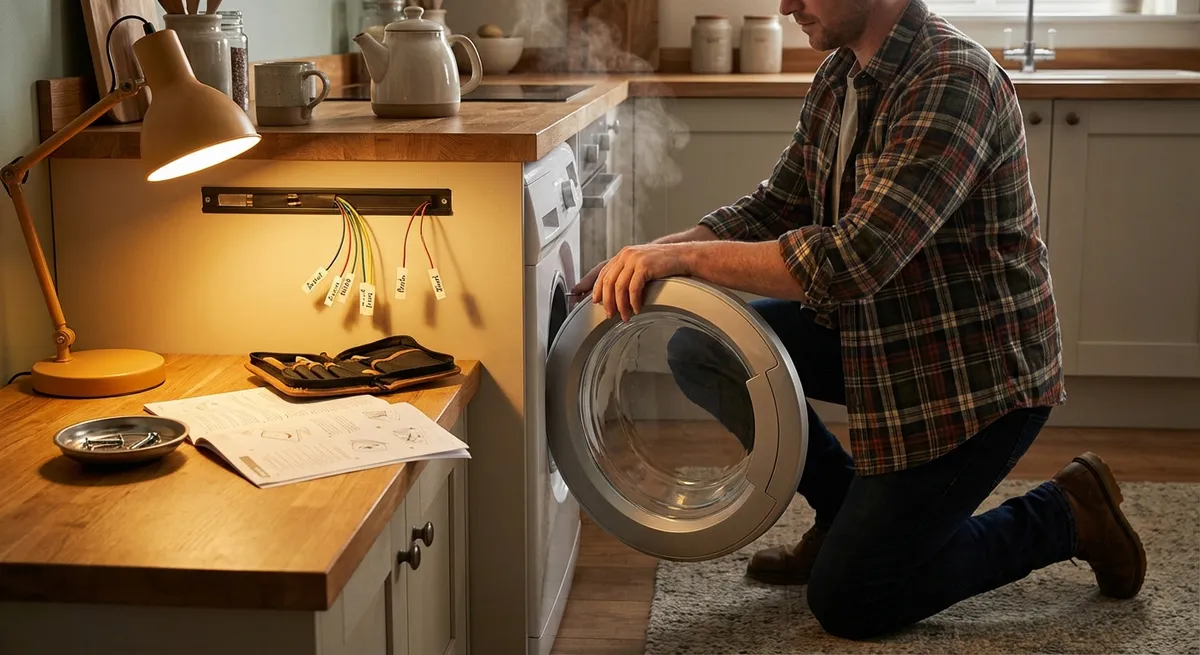
- Document as you go. Take photos with your phone before disconnecting wires or removing panels. You’ll thank yourself when it’s time to reassemble.
Step‑by‑Step Tip #1: Revive a Fridge That’s Not Cooling Well
A warm fridge doesn’t always mean a dying compressor. Often, airflow and coils are the culprits—issues that are very DIY‑friendly.
What you’ll need: Vacuum with brush attachment, soft brush, flashlight, mild soap, towel, screwdriver (for some models).
Steps:
- Confirm the basics. Make sure the fridge is plugged in, the outlet works (test with a lamp), and the temperature control hasn’t been accidentally bumped. Check that doors are closing fully and gaskets (seals) aren’t visibly torn or warped.
- Check interior airflow. Inside the fridge and freezer, look for blocked vents—large boxes, trays, or bags pressed against the back wall can starve the system of airflow. Reorganize so vents have a few inches of clearance.
- Clean the condenser coils.
- Unplug the fridge.
- Find the coils: they may be on the back, under the unit behind a kick plate, or sometimes on the top (consult your manual).
- Use a brush and vacuum to carefully remove dust, pet hair, and lint. Clogged coils force the compressor to work harder and reduce cooling.
- Inspect the door gaskets.
- Close a thin piece of paper or a dollar bill in the door and gently tug; you should feel resistance all around the perimeter.
- If it slides out easily in spots, the gasket may be dirty, warped, or worn.
- Clean gaskets with warm soapy water, dry thoroughly, and check again. Mildly warped sections sometimes respond to careful warming with a hair dryer and reshaping—go slowly and avoid overheating.
- Give it time to stabilize.
- After cleaning and reorganizing, plug the fridge back in, set the temperature to recommended settings (typically around 37–40°F / 3–4°C for fridge, 0°F / −18°C for freezer), and wait 12–24 hours.
- Use a fridge thermometer to verify actual temperatures.
When to call a pro: If you hear loud clicking, buzzing, or see frost building heavily on the back of the freezer, or if temps don’t improve after a full day, you may have a sealed system or control issue that’s beyond simple DIY.
Step‑by‑Step Tip #2: Stop a Washer That Won’t Drain or Finish the Cycle
A washer stuck with a tub full of water is frustrating, but often the problem lies in an easy‑to‑reach filter, hose, or lid switch.
What you’ll need: Bucket or shallow pan, towels, pliers, small brush or old toothbrush, flashlight.
Steps:
- Shut off power and water. Unplug the washer. Turn off the hot and cold water valves at the wall to prevent accidental leaks while you’re working.
- Manually drain standing water.
- For front‑loaders, look for a small access panel at the bottom front. Behind it is often a drain hose and pump filter.
- Place a pan or low container under the hose, slowly open the cap or pull the drain hose plug, and let the water out in stages.
- For top‑loaders without a front access, you may need to remove water with a small container or siphon.
- Clean the pump filter and check for obstructions.
- With water drained, unscrew the pump filter (front‑loaders) or inspect the pump area (check your manual for location).
- Remove lint, coins, small clothing items (like baby socks), and other debris.
- Rinse the filter in warm water and reinstall it securely.
- Inspect the drain hose.
- Move the washer away from the wall slightly.
- Make sure the drain hose at the back is not kinked or crushed.
- If it’s removable, detach it from the washer or standpipe, check for clogs, and flush it out with water.
- Check the lid or door switch.
- Many washers will not spin or drain if the lid/door switch doesn’t register as closed.
- Inspect the striker (the small plastic piece on the lid or door that clicks into the switch). If it’s broken or misaligned, the switch may never engage.
- Lightly press the switch with a non‑metal tool (with power disconnected) to confirm it moves freely. If clearly broken or loose, a replacement switch or striker is often a straightforward DIY swap using a screwdriver.
When to call a pro: Persistent error codes, grinding noises from the pump, or water leaking from under the machine after your checks suggest a failing pump or internal hose, which may require more advanced repair.
Step‑by‑Step Tip #3: Restore Heat to an Electric Dryer That Runs Cold
If your dryer tumbles but clothes stay damp, you might not need a new unit. Restricted airflow or a tripped safety device are common, fixable issues.
What you’ll need: Vacuum with hose, vent brush or long flexible brush, screwdriver, flashlight, multimeter (optional for advanced testing).
Steps:
- Confirm the basics and safety.
- Unplug the dryer.
- For 240V dryers, also switch off the breaker. Electric dryers need both legs of the 240V circuit; a half‑tripped breaker can let it tumble without heat, so reset the double‑pole breaker fully off, then back on.
- Clean the lint filter housing.
- Remove the lint screen and clean it thoroughly.
- Vacuum down into the lint trap housing with a narrow attachment to remove hidden buildup.
- Inspect and clean the exhaust vent.
- Pull the dryer away from the wall and disconnect the vent hose.
- Check the hose for crushed sections, excessive length, or sharp bends.
- Use a vent brush or vacuum to clear lint from both the hose and the wall duct. Go outside and inspect the exterior vent hood; ensure the flap moves freely and isn’t blocked by lint or nests.
- Run a quick test (with caution).
- Reconnect the vent loosely or leave it off briefly for testing (only if you can safely exhaust into a large, ventilated space and there’s no gas dryer involved).
- Plug the dryer back in, start a timed heat cycle, and check if you feel strong warm air from the exhaust within a few minutes. If airflow is good and hot, reconnect everything securely.
- Check safety thermostats and heating element (advanced).
- If airflow is good but there’s still no heat, many dryers have a thermal fuse or high‑limit thermostat that opens when overheated. These are usually mounted on or near the blower housing or heating element.
- With power disconnected, you can test these components with a multimeter for continuity (per the wiring diagram or service manual). A blown thermal fuse must be replaced—not bypassed—and usually indicates previous overheating from vent issues.
When to call a pro: If new fuses blow again, the heating element is visibly damaged, or you’re uncomfortable testing live circuits or internal components, a qualified technician is the safer path.
Step‑by‑Step Tip #4: Quiet a Dishwasher That’s Not Cleaning Properly
Cloudy glasses, food stuck on plates, or a musty smell often mean your dishwasher needs a careful cleaning and a few checks, not replacement.
What you’ll need: Vinegar, small brush or old toothbrush, toothpicks or soft wire, mild dish soap, towels, possibly a screwdriver.
Steps:
- Check water temperature and detergent.
- Dishwashers clean best with incoming water around 120°F (49°C). Run hot water at the sink first and see how long it takes to get hot. If it never gets very warm, adjust your water heater (safely) or call a plumber.
- Confirm you’re using dishwasher‑specific detergent and the right amount; too much can leave residue, too little can leave soil.
- Clean the filter and sump.
- Remove the bottom rack.
- Look for a cylindrical or flat filter assembly at the bottom; twist or lift it out per the manual.
- Rinse under warm water, using a soft brush to remove grease and food. Check the sump area for debris like bones, glass, or labels and carefully remove them.
- Clear the spray arms.
- Remove upper and lower spray arms if your model allows (usually they twist or pull off).
- Rinse them under running water. Use toothpicks or a soft wire to gently clear food from the tiny holes, but don’t enlarge them.
- Reinstall the arms so they spin freely.
- Inspect the float and inlet screen.
- The float (small dome or cylinder inside the tub) tells the dishwasher when the water level is correct. Make sure it moves up and down easily and isn’t stuck by debris or soap scum.
- At the water inlet under the machine, there may be a small screen that protects the valve. If accessible, clean it gently to improve water flow (consult your manual for location).
- Run a cleaning cycle.
- With the dishwasher empty and filters reinstalled, place a cup of white vinegar upright on the top rack.
- Run a hot wash cycle to help break down grease and mineral buildup.
- For heavy buildup, follow up with a commercial dishwasher cleaner according to label instructions.
When to call a pro: If the dishwasher is not filling, not draining at all, or displaying persistent error codes after cleaning, you may be dealing with a faulty fill valve, drain pump, or control board.
Step‑by‑Step Tip #5: Rescue an Electric Oven with Uneven or No Heat
Baked goods burning on one side or an oven that never reaches temperature might be suffering from a failing element, dirty sensor, or calibration issue.
What you’ll need: Oven thermometer, screwdriver, flashlight, mild cleaner, possibly a multimeter.
Steps:
- Verify the actual temperature.
- Place an oven‑safe thermometer in the center of the middle rack.
- Set the oven to 350°F (about 177°C) and let it preheat fully, then check the thermometer.
- If you see a consistent difference (e.g., always 25–50°F off), the oven may need calibration via its control panel settings (see your manual).
- Inspect heating elements (electric ovens).
- Unplug the oven or turn off the breaker.
- Visually inspect the bake (bottom) and broil (top) elements for blisters, cracks, or breaks.
- A visibly broken or burnt‑through element won’t heat properly and needs replacement.
- Test elements and connections (advanced).
- Carefully remove the mounting screws securing the element inside the oven and gently pull it forward to access the wiring.
- Check for loose or burnt wire connections.
- With the element disconnected and power off, test for continuity using a multimeter; an open circuit usually means a bad element.
- Clean the temperature sensor and interior.
- The sensor (a thin metal rod, usually on a rear wall inside the oven) should be clean and unobstructed. Grease or foil touching it can cause inaccurate readings.
- Avoid lining the entire oven with foil; it can block airflow and skew temperatures.
- Clean heavy grease or baked‑on residue with appropriate oven cleaners, following safety directions.
- Check for door seal issues.
- Inspect the oven door gasket for gaps, tears, or hardened, flattened sections.
- A compromised seal lets heat escape and can cause poor or uneven baking. Many gaskets are held in by clips and can be replaced with basic tools.
When to call a pro: Gas oven ignition problems, strong gas smells, error codes that persist after a power reset, or control panel failures should be handled by a qualified technician due to safety risks.
Conclusion
Most appliance breakdowns don’t start as catastrophic failures—they begin as small, fixable problems: clogged vents, grimy filters, obstructed fans, and worn seals. By learning a methodical approach—power off, inspect, clean, test—you can often restore performance, extend the life of your machines, and avoid premature replacements. When you run into symptoms that point to gas leaks, sealed systems, or complicated electronics, that’s your cue to stop, document what you’ve found, and hand it off to a pro. The more familiar you become with how your appliances should sound, look, and run, the easier it is to catch issues early—and keep your home running smoothly.
Sources
- [U.S. Department of Energy – Appliances & Equipment](https://www.energy.gov/energysaver/appliances-and-electronics) - Covers how appliances use energy, recommended temperatures, and basic maintenance tips that improve performance
- [Consumer Reports – Appliance Repair or Replace?](https://www.consumerreports.org/appliance-repairs/repair-or-replace-appliances-a6216794183/) - Offers guidance on when DIY repair makes sense versus calling a professional or replacing an appliance
- [Whirlpool Product Help](https://producthelp.whirlpool.com/) - Official troubleshooting and maintenance information for common home appliances, including dishwashers, washers, dryers, and refrigerators
- [Safety Tips for Using Electrical Appliances – U.S. Fire Administration](https://www.usfa.fema.gov/prevention/outreach/electrical.html) - Provides essential safety guidance for working with and around electrical appliances in the home
- [University of California Agriculture & Natural Resources – Refrigerator & Freezer Storage](https://ucanr.edu/sites/foodsafety/Consumer_Updates/Refrigerator_and_Freezer_Storage/) - Explains proper refrigerator temperatures and practices that relate directly to diagnosing cooling issues
Key Takeaway
The most important thing to remember from this article is that this information can change how you think about Appliances.