Car problems don’t always mean a trip to the shop or a big bill. With a few basic tools, some patience, and the right steps, you can handle a surprising amount of auto repair right in your driveway—safely and confidently.
This guide walks through five practical, step‑by‑step fixes that many DIYers can tackle. Each one focuses on common issues that cost money at the shop but are manageable at home if you follow instructions carefully.
Always work safely: use jack stands, wear eye protection, and stop if you’re unsure. When in doubt, consult a certified mechanic.
Before You Start: Tools, Safety, and When to Say “Stop”
Before diving into specific repairs, set yourself up for success:
- Basic tools: metric/SAE socket set, ratchet, combination wrenches, screwdrivers, pliers, torque wrench, jack and jack stands, work light, funnel, drain pan, gloves.
- Manuals & references: your owner’s manual plus a repair guide (Haynes/Chilton) or a reputable online database.
- Safety first: flat, solid surface; parking brake engaged; wheel chocks; safety glasses; gloves; no loose clothing; good ventilation if running the engine.
Know when to stop:
- Fluid leaking heavily and you can’t identify it
- Check engine light flashing (not just steady)
- Strong fuel smell or visible fuel leak
- Brakes feel spongy after your repair
- Anything overheating, smoking, or making loud metal‑on‑metal noise
If you hit one of those, it’s time for a professional—not improvisation.
Step‑By‑Step Tip #1: Replacing Worn Brake Pads
Worn brake pads can squeal, grind, and dramatically reduce stopping power. On many cars, front pad replacement is a very realistic DIY job if you’re methodical.
You’ll need: jack, jack stands, lug wrench, socket set, C‑clamp or disc brake spreader, new pads, brake cleaner, bungee cord or wire, shop rags.
Steps:
Prepare and lift the car
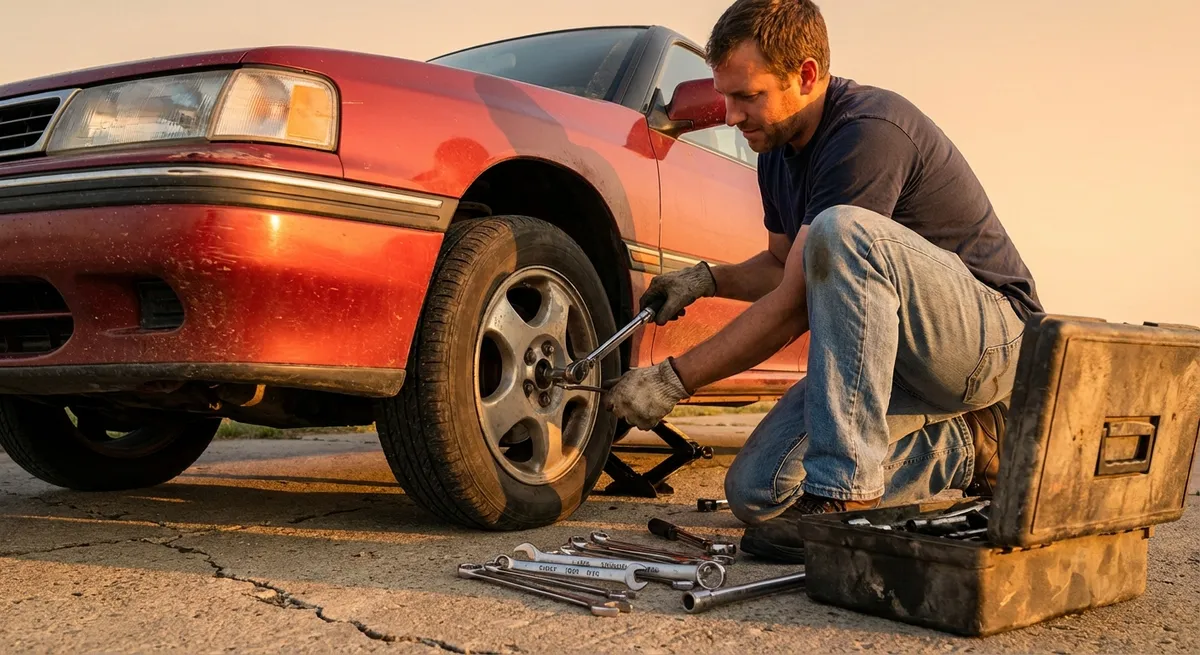
Park on level ground, engage the parking brake (for front pads), and chock the rear wheels. Loosen wheel lug nuts slightly (¼ turn). Jack up the vehicle at the correct lift point and place it securely on jack stands. Remove the wheel fully.
Inspect the brake assembly
Locate the caliper over the rotor. Look for wetness around the caliper (could indicate leaks), deep rotor grooves, or severely uneven pad wear. If anything looks extreme or damaged, pause and consult a professional.
Remove the caliper and old pads
Remove the caliper slide bolts (usually on the back of the caliper). Carefully slide the caliper off the rotor and hang it from the suspension with a bungee or wire—never let it dangle by the hose. Remove the old pads from the bracket and note their orientation and any clips or shims.
Compress the caliper piston
Place an old pad against the piston and use a C‑clamp or spreader to gently compress the piston back into the caliper. Go slowly and watch your brake fluid reservoir under the hood—if it’s very full, you may need to remove some fluid with a clean syringe or turkey baster so it doesn’t overflow.
Install new pads and reassemble
Clean the bracket and rotor surface with brake cleaner. Install any new hardware clips that came with the pads. Slide the new pads into place. Refit the caliper over the pads and reinstall the caliper bolts, tightening to the torque specified in your manual. Reinstall the wheel, snug the lug nuts by hand, lower the car, and torque the lug nuts in a star pattern.
Test before driving
Pump the brake pedal several times until it feels firm—this seats the pads. Check fluid level, top off if needed, then do a low‑speed test in a safe area before driving normally.
Step‑By‑Step Tip #2: Swapping a Dead Starter Motor
If you turn the key and hear a single click—or nothing at all—your starter may be the culprit. On many vehicles, especially older or simpler models, starter replacement is very doable.
You’ll need: socket set, extensions, ratchet, wrenches, safety glasses, replacement starter, battery terminal puller (optional), creeper or mat.
Steps:
Confirm the symptoms
Check that the battery is charged and the terminals are clean and tight. If lights work normally but the engine won’t crank (or just clicks), the starter is a suspect. If possible, test battery voltage (around 12.6 V fully charged).
Disconnect the battery
Always disconnect the negative battery terminal first to avoid shorts. Secure the cable away from the post so it can’t accidentally reconnect.
Locate the starter
On most vehicles, it’s near where the engine meets the transmission. You may need to raise the vehicle and support it with jack stands to access it from underneath.
Label and remove wiring
Before disconnecting, take a photo of the wiring on the starter. Remove the smaller signal wire connector and then the larger power cable (usually held by a nut). Keep track of any insulators or washers.
Remove the starter
Locate the mounting bolts (typically 2–3). Support the starter with one hand as you remove the last bolt; it’s heavier than it looks. Lower it carefully.
Install the new starter
Compare the old and new units to ensure they match (mounting holes, connector locations). Position the new starter and install mounting bolts finger‑tight first, then torque to spec. Reconnect the power cable and signal wire as per your photo or manual.
Reconnect the battery and test
Reconnect the negative battery terminal. Start the engine and listen for normal cranking without grinding or unusual noises. If you hear grinding, shut it off and recheck mounting and alignment.
Step‑By‑Step Tip #3: Fixing a Leaky Valve Cover Gasket
Burning‑oil smells, light smoke from the engine bay, or oil on top of the engine often point to a leaking valve cover gasket. Fixing it helps prevent more serious issues and keeps your engine bay cleaner.
You’ll need: socket set, torque wrench, gasket scraper or plastic razor blade, brake cleaner or solvent, new valve cover gasket (and spark plug tube seals if applicable), rags.
Steps:
Access the valve cover
Let the engine cool completely. Remove any plastic engine covers. Disconnect ignition coils or plug wires that go through the valve cover, plus any vacuum lines or sensors attached to it. Label connectors if needed.
Remove the valve cover
Loosen and remove the valve cover bolts in a criss‑cross pattern. Gently pry the cover loose if it’s stuck—avoid metal tools that could gouge the sealing surface. Lift the cover straight up.
Clean the sealing surfaces
Peel off the old gasket. Use a gasket scraper or plastic blade to carefully clean the mating surface on both the cover and cylinder head—no old rubber or sealant should remain. Avoid dropping debris into the engine; stuff clean rags around exposed areas if needed.
Install the new gasket
Clean the valve cover thoroughly and let it dry. Fit the new gasket into the groove in the cover. If your engine uses spark plug tube seals, replace those now. Some manufacturers call for a dab of RTV sealant at specific corners—follow the repair manual for your exact engine.
Reinstall the cover and torque bolts
Place the cover back onto the engine, making sure the gasket stays seated. Install bolts finger‑tight, then torque them in the recommended sequence and to the specified value—overtightening can warp the cover and cause new leaks.
Reconnect and inspect
Reconnect coils/plug wires, hoses, and sensors. Start the engine and let it idle. Inspect for any new leaks around the gasket edge. After a short drive, check again to confirm everything remains dry.
Step‑By‑Step Tip #4: Changing an Automatic Transmission Filter and Fluid (Pan Service)
A pan‑drop service (not a full fluid exchange) is within reach for many DIYers and can greatly improve shifting feel and transmission life—if done correctly.
You’ll need: jack, jack stands, drain pan, socket set, gasket scraper, new transmission filter and pan gasket, manufacturer‑spec transmission fluid, funnel, rags, safety glasses.
Steps:
Verify procedure and fluid type
Check your owner’s manual or a repair database for: correct fluid spec, capacity, and whether your transmission even has a serviceable filter and pan. Some modern units are “sealed” and better left to professionals.
Safely lift the vehicle
Warm the transmission slightly by driving for a few minutes, then park on level ground. Raise the vehicle, support it with jack stands, and put the drain pan under the transmission pan.
Drain and remove the pan
Some pans have a drain plug—if so, remove it and drain the fluid. If not, loosen pan bolts from one side while keeping the opposite side snug so fluid drains from one edge into your pan. Once drained, remove all bolts and lower the pan carefully; more fluid may remain.
Clean the pan and magnet
Remove the old gasket from the pan and transmission case. Clean the pan thoroughly with brake cleaner. Wipe metal shavings and sludge from the pan magnet—some fine metallic paste is normal, but large chunks can indicate internal wear.
Replace the filter and gasket
Remove the old transmission filter (usually a few bolts or clips). Some fluid will spill; catch it. Install the new filter, ensuring any O‑rings seat properly. Install a new pan gasket (or RTV if specified by the manufacturer) on the cleaned pan.
Reinstall the pan and refill
Bolt the pan back on, tightening evenly in a criss‑cross pattern to the specified torque. Lower the vehicle. Add the correct amount of new transmission fluid through the dipstick tube (if equipped) with a funnel—start with slightly less than the full capacity, then top up gradually.
Check level with engine running
With your foot on the brake and wheels chocked, start the engine, move the shifter slowly through all gears, then return to Park. With the engine idling on level ground, check the fluid level using the transmission dipstick (if the design uses one) and adjust as necessary. Follow your manual’s specific procedure—it varies by vehicle.
Step‑By‑Step Tip #5: Tracking Down and Fixing a Parasitic Battery Drain
If your battery dies after sitting overnight or a couple of days, you may have a parasitic drain—something in the car pulling power when it shouldn’t. You can often track this down with a basic multimeter.
You’ll need: digital multimeter (with 10A fuse), wrench for battery terminals, fuses diagram, patience.
Steps:
Confirm it’s a drain, not a bad battery
Have the battery tested at a parts store or with your own tester. Verify the alternator charges properly (about 13.5–14.5 V with engine running). If both check out, a drain is more likely.
Prepare the vehicle
Turn everything off and remove the key. Close all doors (or manually latch door sensors). Allow the car to sit for at least 20–30 minutes so modules can go to “sleep.”
Connect the meter in series
Set your multimeter to the 10A DC setting. Disconnect the negative battery cable. Connect the meter leads between the negative battery post and the disconnected cable (one lead on each). Do not attempt to start the car with the meter in place.
Read the draw
After a minute or two, note the reading. Typical modern vehicles may show 20–50 milliamps (0.02–0.05 A) of draw. Anything significantly higher—like 0.2 A (200 mA) or more—is likely excessive.
Pull fuses to isolate the circuit
With the meter still connected, pull one fuse at a time from your interior or engine bay fuse boxes. When the current drops sharply, you’ve found the circuit causing the drain. Note that some circuits need time to “sleep” after reinstalling fuses; be patient.
Investigate components on that circuit
Once you know the suspect fuse, consult your owner’s manual to see what it powers (e.g., radio, interior lights, power seats, aftermarket alarms). Common culprits: stuck glove box/ trunk lights, faulty relays, old stereos, or aftermarket accessories wired incorrectly.
Repair or disconnect the offender
Repair or replace the faulty component, or disconnect aftermarket accessories to confirm the drain stops. Recheck current draw with the meter to verify it’s now within a reasonable range before calling the job done.
Conclusion
Many auto repairs that seem intimidating at first are actually manageable with clear steps, basic tools, and respect for safety. Replacing brake pads, swapping a starter, fixing a valve cover leak, servicing transmission fluid and filter, and tracking down a battery drain are all within reach for careful DIYers.
The key is preparation: read your manual, gather the right tools, work methodically, and know when to call in a professional. Every successful repair you complete builds experience—and that experience turns into real savings and more confidence every time you pop the hood.
Sources
- [National Highway Traffic Safety Administration (NHTSA) – Vehicle Safety and Maintenance](https://www.nhtsa.gov/road-safety/vehicle-maintenance) – Federal guidance on safe vehicle maintenance practices and safety considerations
- [AAA – Car Care Resources & How‑To](https://exchange.aaa.com/automotive/car-care/) – Practical maintenance and repair tips, including brakes, batteries, and fluids
- [U.S. Department of Energy – Fuel Economy: Keeping Your Car in Shape](https://www.fueleconomy.gov/feg/maintain.jsp) – Explains how proper maintenance (fluids, brakes, leaks) affects performance and efficiency
- [Haynes – How‑To Guides](https://haynes.com/en-us/tips-tutorials) – Detailed DIY repair tutorials and overviews for common systems like brakes and starting/charging
- [Pennsylvania College of Technology – Automotive Tips](https://www.pct.edu/articles/automotive-tips) – Educational articles on basic automotive systems and safe DIY service practices
Key Takeaway
The most important thing to remember from this article is that this information can change how you think about Auto Repair.