If you own a car long enough, something is going to rattle, leak, or refuse to start at the worst possible time. You don’t need a full shop or fancy tools to handle basic issues—just some patience, a few essentials, and a clear plan. This guide walks through five practical, step‑by‑step repairs you can safely do in your own driveway, even if you’re not a seasoned gearhead.
These aren’t “reinvent your engine” projects. They’re realistic, money‑saving fixes that build your confidence and keep your car on the road longer.
Before You Start: Safety and Tools You Actually Need
Jumping into car repair without some basics in place is how knuckles get busted and parts get broken. Spend a few minutes setting yourself up the right way.
Core safety habits:
- Always work on a flat surface with the parking brake fully engaged.
- Use wheel chocks (or bricks in a pinch) to block the wheels if you’re lifting the car.
- Never rely on a jack alone. Support the car with proper jack stands rated for your vehicle’s weight.
- Let the engine cool before working near the radiator, hoses, or exhaust.
- Disconnect the negative battery terminal when working on electrical components beyond simple bulb or battery swaps.
Basic tool kit that covers most DIY jobs:
- Socket set with metric and SAE sockets (including deep sockets for spark plugs and some suspension nuts)
- Combination wrenches (10mm and 13mm get used a lot)
- Screwdrivers (Phillips and flathead, various sizes)
- Pliers (needle‑nose, slip‑joint, and locking pliers if possible)
- Torque wrench (for lug nuts, spark plugs, and other bolts that must be tightened to spec)
- Multimeter (for basic electrical diagnosis)
- Work light or headlamp
- Nitrile gloves, rags, and a drain pan for fluids
Keep your owner’s manual handy—it’s often the fastest way to find fluid specs, bulb types, fuse locations, and torque values.
Fix 1: Brake Pad Replacement for Cleaner Stops
Worn brake pads are one of the most common and critical wear items on any car. If you hear squealing or grinding when braking, or the car takes longer to stop, it may be time for new pads. On most disc brake systems, this is a manageable DIY job with basic tools.
Step‑by‑step:
- Confirm pad wear.
Turn the steering wheel to expose the front brakes. Look through the wheel spokes: if the pad material is thinner than about 3 mm (roughly a couple of credit cards), they’re due. Grinding noise usually means they’re overdue.
- Loosen lug nuts and lift safely.
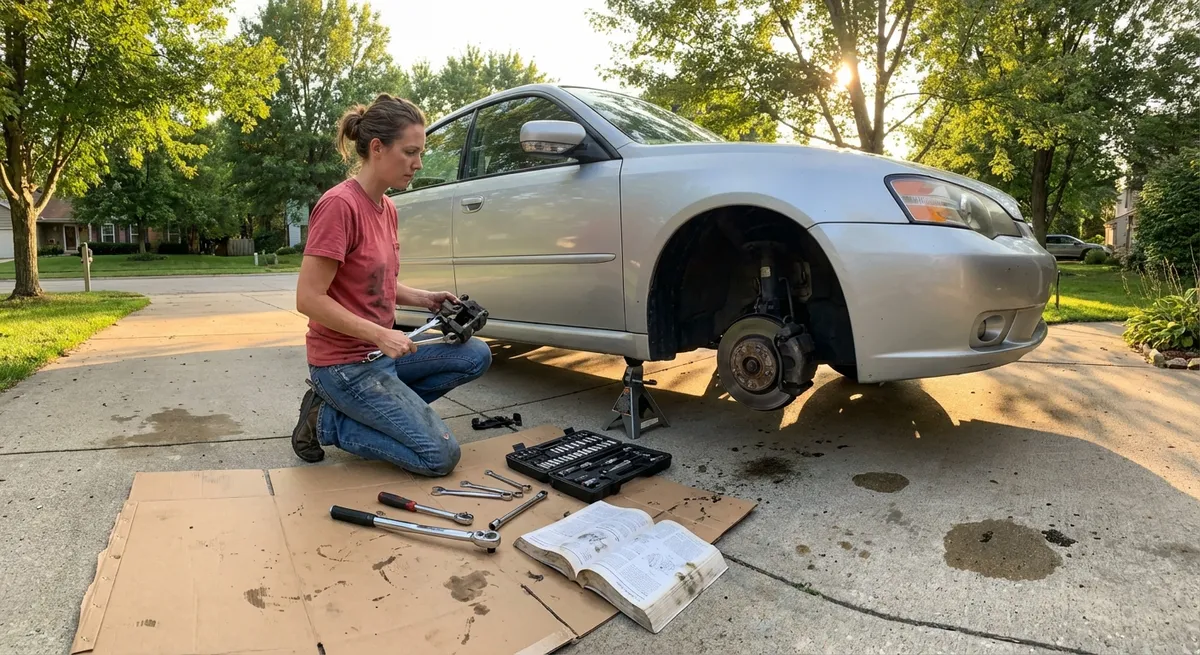
With the car on the ground, slightly loosen the lug nuts (don’t remove them). Jack up the car at the recommended lift points and place jack stands under the pinch weld or frame points specified in your manual. Lower the car onto the stands and remove the wheel.
- Remove the caliper.
Find the caliper bolts on the back of the brake assembly. Remove them with the correct socket or wrench. Carefully slide the caliper off the rotor. Use a bungee cord or wire to hang it from the suspension—don’t let it dangle by the brake hose.
- Remove old pads and prep hardware.
Slide out the old pads. Remove the pad clips or hardware from the caliper bracket. Clean the contact points on the bracket with a wire brush and brake cleaner. Install the new hardware clips that came with your pads if supplied.
- Compress the caliper piston.
Use a C‑clamp or a disc brake piston tool to gently push the caliper piston back into the caliper housing. Open the brake fluid reservoir cap slightly beforehand to relieve pressure. Go slowly to avoid damaging seals.
- Install new pads.
Apply a thin layer of high‑temperature brake grease to the pad backing plates and hardware contact points (not on the pad friction surface or rotor). Slide the new pads into place, ensuring they are seated correctly in the clips.
- Reinstall caliper and wheel.
Place the caliper over the new pads and reinstall the caliper bolts to the specified torque. Refit the wheel, hand‑tighten lug nuts, lower the car, then torque lugs in a star pattern to manufacturer specs.
- Test before driving.
Pump the brake pedal several times before moving the car to seat the pads and restore pedal pressure. Do a low‑speed test in a safe area. New pads often need a brief “bed‑in” process (a series of moderate stops); follow the pad manufacturer’s instructions.
Fix 2: Diagnose and Replace a Weak Battery
Modern vehicles are power‑hungry, and a weak battery can create all kinds of strange behavior—from flickering lights to random warning messages. Swapping a battery is straightforward, but diagnosing it first prevents you from replacing a good battery when the real problem is elsewhere.
Step‑by‑step:
- Watch for classic battery symptoms.
Slow cranking, dim headlights at idle, clicking when turning the key, or needing frequent jump starts point toward a weak battery. If electronics reset randomly (radio presets, clock), that’s another clue.
- Visual inspection.
With the engine off, pop the hood and find the battery. Check for corrosion (white or green crust) on terminals, swollen battery case, or leaking fluid. Light corrosion can be cleaned—severe swelling or leaks mean replacement.
- Test voltage with a multimeter.
Set your multimeter to DC volts. Place the red lead on the positive terminal and the black on the negative. A healthy, fully charged battery should read about 12.6 volts or slightly more. Readings under ~12.2 volts suggest low charge; below 12.0 is significantly discharged. If available, use a battery load tester or have a parts store do a free load test to confirm.
- Prepare for replacement.
If replacement is needed, record radio codes or settings if your car requires them. Wear eye protection and gloves. Turn the ignition off and remove the key. Do not smoke or spark near the battery.
- Disconnect and remove the old battery.
Always disconnect the negative (–) terminal first to reduce the risk of short circuits, then the positive (+). Loosen the hold‑down clamp or bracket and carefully lift the battery straight up—car batteries are heavy, so use both hands and a stable stance.
- Clean the area and terminals.
Use a battery terminal brush or wire brush to clean the cable ends. If there’s acid corrosion, a paste of baking soda and water can neutralize it (wipe clean afterward). Ensure the battery tray is dry and free of debris.
- Install the new battery.
Place the new battery in the tray, matching the orientation of the old one (positive and negative in the same positions). Secure it firmly with the hold‑down. Reconnect the positive terminal first, then the negative. Tighten snugly but don’t over‑crush the clamps.
- Final checks.
Start the car and confirm strong cranking and normal electrical behavior. Check that battery warning lights are off. Reset the clock, radio, and any window/door auto‑functions per your owner’s manual.
Dispose of the old battery properly—most auto parts stores accept used batteries for recycling and may give a small core credit.
Fix 3: Stop an Oil Leak at the Drain Plug or Filter
A small oil spot on your driveway doesn’t always mean a catastrophic engine issue. Two common leak points you can address yourself are the oil drain plug and the oil filter—especially if they were installed incorrectly during a previous oil change.
Step‑by‑step:
- Confirm where the leak is coming from.
Park on a clean, flat surface and slide cardboard under the engine overnight. In the morning, look underneath with a flashlight. If oil is dripping directly from the drain plug or oil filter, you have a good candidate for a DIY fix.
- Check oil level and safety.
Before working, make sure the oil level is still in the safe range on the dipstick. If it’s near or below the low mark, top it up. Let the engine cool before touching any components.
- Tighten the oil filter.
Place your hand around the oil filter (or use an oil filter wrench if needed). Most filters only need to be “hand tight plus a bit.” If the filter turns easily, someone may not have tightened it enough. Snug it according to the filter manufacturer’s instructions—usually hand tight, then an additional ¾ turn.
- Inspect the filter gasket.
If the leak persists, remove the filter entirely (have a drain pan ready for oil). Check that the old rubber gasket isn’t stuck to the engine mounting surface—double‑gasketed filters almost always leak. Clean the surface, lightly oil the new filter’s gasket, and reinstall per instructions.
- Check the drain plug.
With the car safely lifted and supported if needed, inspect the drain plug. Use the correct socket or wrench to gently tighten it. Do not over‑tighten; you can strip the threads in the oil pan. Spot any missing or cracked crush washer (on many vehicles, the washer must be replaced every oil change).
- Replace a damaged drain plug or washer.
If the plug is rounded off or the washer is clearly deformed, plan to replace them. You’ll need to drain the oil into a pan, swap to a new OEM‑spec drain plug and washer, then refill the oil to spec. Use a torque wrench if your manual specifies a value for the drain bolt.
- Clean and re‑check.
Wipe all surfaces clean with a rag and brake cleaner so you can see if fresh oil appears. After driving a short distance, check again. If the leak persists or appears to be coming from higher up on the engine, it may be a gasket or seal issue that’s beyond a quick driveway fix.
Fix 4: Restore Headlights That Barely Light the Road
Cloudy, yellowed headlights are more than cosmetic—they can dramatically cut your nighttime visibility. Replacing entire headlight assemblies can get expensive, but restoring the plastic lenses is a very approachable DIY job that only takes an hour or so.
Step‑by‑step:
- Evaluate the damage.
If the haze is on the outside and feels rough to the touch, a restoration kit is likely all you need. If you see moisture or heavy condensation inside the housing, that’s a separate sealing issue.
- Gather supplies.
You can use a dedicated headlight restoration kit or assemble your own: various grits of wet/dry sandpaper (e.g., 600, 1000, 2000), masking tape, spray bottle with water, plastic polish or rubbing compound, microfiber cloths, and a UV sealant or clear coat designed for headlights.
- Prep the area.
Wash the headlights and surrounding bodywork. Mask around the headlights with painter’s tape to protect the paint. Work in shade; direct sun can dry polish and water too quickly.
- Wet sand the surface.
Start with the coarsest recommended grit (often 600–800). Wet the sandpaper and headlight, then sand in one direction with light pressure. The lens will look worse (milky)—this is normal. Progress to finer grits, changing the sanding direction slightly each step to remove the previous scratches.
- Polish to clarity.
Once you’ve finished with the finest sandpaper, dry the headlight. Apply plastic polish or the kit’s compound to a microfiber cloth or foam pad. Polish the lens in circular motions until it becomes clear and glossy. You can use a low‑speed drill with a polishing pad if the kit allows it, but hand‑polishing works fine.
- Seal with UV protection.
This is critical. Without a UV‑resistant sealant, the plastic will quickly haze again. Apply the included sealant or a dedicated UV‑protective clear coat according to the product directions. Allow it to cure fully before driving or washing the car.
- Check aim and performance.
After dark, park facing a wall on level ground and compare your before/after output. If the beams are too low or high, consult your manual for headlight aim adjustment procedures.
Fix 5: Track Down a Misfire with a Basic Tune‑Up
A rough idle, shaking under acceleration, or a flashing check engine light can all point to an engine misfire. While serious issues require a pro, many misfires come from simple ignition parts: spark plugs and ignition coils. Replacing these on many engines is entirely doable at home.
Step‑by‑step:
- Confirm it’s a misfire.
If the check engine light is on, use an OBD‑II scanner (many parts stores will scan for free) to read the codes. Misfire codes appear as P0300 (random/multiple) or P0301–P030X (cylinder‑specific). Note the cylinder number—this guides your next steps.
- Inspect ignition components.
With the engine off and cool, remove the plastic engine cover (if present). Locate the ignition coils or spark plug wires. Look for obvious damage: cracked coils, frayed wires, oil in spark plug wells, or loose connectors.
- Check and replace spark plugs.
One cylinder at a time, disconnect the coil or plug wire and remove it. Use a spark plug socket and extension to remove the plug. Check the plug’s condition: heavy carbon, oil fouling, or cracked insulators indicate problems. Compare to the new plug you’ll install and ensure it matches the recommended type and gap.
- Install new plugs correctly.
If needed, gently adjust the gap to spec using a gapping tool. Thread the new plug in by hand first to avoid cross‑threading, then tighten with a torque wrench to the value specified in your manual. Over‑tightening can strip threads; under‑tightening can cause poor sealing.
- Swap coil packs for diagnosis.
If a single cylinder misfire persists, you can swap that cylinder’s ignition coil with one from a known good cylinder. Clear the code and drive briefly. If the misfire code “follows” the coil to the new cylinder, that coil is likely bad and should be replaced.
- Check for vacuum leaks.
A hissing sound near the intake manifold or cracked vacuum hoses can also cause misfires. With the engine idling, gently wiggle hoses and listen for changes in idle quality. Replace any obviously brittle, cracked, or collapsed hoses.
- Retest and monitor.
After replacing plugs and any suspect coils or hoses, clear the codes and test drive. If misfire codes return or you notice fuel smells, severe shaking, or poor power, it’s time to stop DIY attempts and get a professional diagnosis.
Conclusion
Taking on basic auto repairs at home doesn’t just save money—it gives you real control over your vehicle’s health and helps you spot issues before they become emergencies. By starting with practical jobs like brake pads, batteries, small oil leaks, headlight restoration, and simple misfire diagnosis, you build skills that pay off every time you turn the key.
Work methodically, respect safety, and don’t be afraid to stop and look something up in your manual or from a trusted source. Over time, your driveway becomes more than just a parking spot—it becomes your own small, capable workshop.
Sources
- National Highway Traffic Safety Administration (NHTSA) – Vehicle Maintenance Tips – General safety and maintenance guidance to support safe DIY work
- AAA – Car Care: Do-It-Yourself Maintenance – Practical advice on basic car care tasks and when to seek a professional
- Advance Auto Parts – How to Change Brake Pads – Detailed brake pad replacement walkthrough with photos
- Interstate Batteries – How to Replace a Car Battery – Step‑by‑step battery replacement with safety tips
- Penn State Extension – Understanding Motor Oil and Filters – Background on engine oil, filters, and why proper sealing matters
Key Takeaway
The most important thing to remember from this article is that this information can change how you think about Auto Repair.